Voqerlynax
Cloud Series
Cloud Series
Couldn't load pickup availability
1. Problem Statement
Learners can understand many individual C# concepts while still finding it difficult to combine them inside one broad structure. Models, services, validation rules, storage components, events, and processing workflows may be created separately without a clear connection plan. As the codebase grows, responsibilities can overlap and data movement may become difficult to trace. Changes to one requirement can then affect several components that were not designed to communicate clearly. A complete architecture exercise is needed to bring earlier knowledge into one coordinated learning experience.
2. Solution
Cloud Series provides a project-centred route through the planning and construction of a broad C# structure. Learners begin with written requirements and gradually define models, responsibilities, contracts, workflows, and communication boundaries. Each module adds one connected part while preserving the structure created in earlier sections. Review checkpoints encourage learners to examine naming, dependencies, repeated logic, and information movement before continuing. The final stage includes a structured evaluation and a written plan for future adjustments.
3. What’s Inside
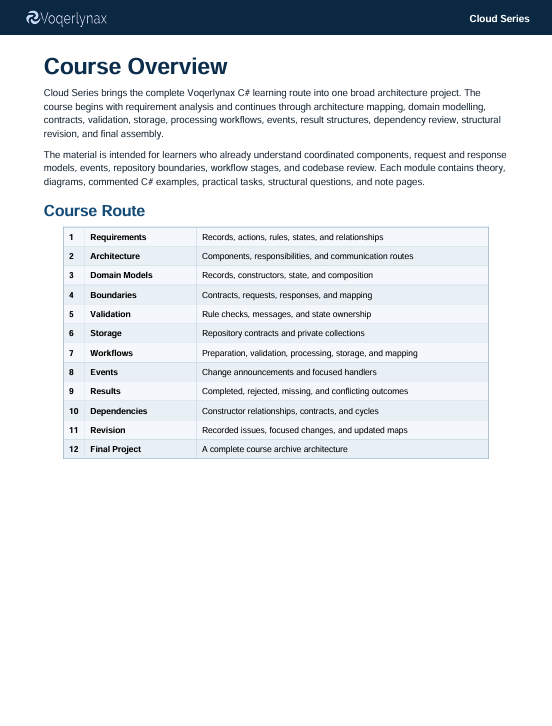
Module 1: Requirement Analysis
Learners study a detailed project brief and separate it into records, actions, rules, states, and relationships. Worksheets help identify which ideas may become classes, methods, properties, or validation conditions.
Module 2: Architecture Mapping
This module introduces a complete component map. Learners define the role of data models, processing services, storage components, coordinators, and shared contracts before implementation begins.
Module 3: Domain Modelling
Learners create classes that represent the central information within the project. Lessons cover identifiers, constructors, properties, related records, state values, and controlled updates.
Module 4: Contracts and Boundaries
This section examines interfaces and focused communication models. Learners define how components exchange information without relying directly on internal implementation details.
Module 5: Validation Structure
Learners create reusable rules for text, numbers, grouped records, dates, and state changes. Validation results are organised into readable structures that can move through the wider workflow.
Module 6: Storage Components
This module covers collection-based storage behaviour through focused classes. Learners create methods for adding, locating, editing, grouping, and removing records while keeping storage concerns separate.
Module 7: Processing Workflows
Learners divide broader operations into preparation, validation, calculation, update, and result stages. Flow diagrams show how information travels through each part.
Module 8: Events and Related Actions
This section introduces communication around completed changes. Learners create events, handlers, and activity records that allow related components to respond without direct control from the original class.
Module 9: Error and Result Structures
Learners organise rejected values, missing records, interrupted operations, and completed actions through consistent result objects. Exercises focus on keeping descriptions informative and connected to the relevant responsibility.
Module 10: Dependency Review
This module examines how classes rely on one another. Learners revise unnecessary connections, introduce suitable contracts, and document the direction of communication.
Module 11: Structural Revision
Learners review broad methods, repeated rules, unclear names, and overlapping responsibilities. Guided refactoring tasks preserve the intended behaviour while improving organisation.
Module 12: Final Architecture Project
The concluding project combines models, interfaces, storage logic, validation, events, workflows, and result structures. Learners complete a component map, write the central code sections, review communication paths, and prepare documentation explaining their decisions.
Included Materials
Cloud Series includes written modules, code examples, requirement worksheets, architecture diagrams, workflow maps, validation tables, refactoring exercises, review questions, documentation templates, and a concluding multi-component project.
4. Who Is This For?
Cloud Series is intended for learners who already understand object-oriented C# concepts, collections, interfaces, layered organisation, events, validation, and coordinated workflows. It suits learners continuing from Peak Series and those seeking a detailed architecture-focused study project.
5. What You’ll Learn
- Translate written requirements into components
- Build structured domain models
- Define clear class responsibilities
- Create interfaces and communication boundaries
- Organise reusable validation rules
- Separate storage and processing concerns
- Build multi-stage workflows
- Coordinate related actions through events
- Create structured operation results
- Trace information across several components
- Review dependency direction
- Refactor repeated logic
- Document architecture decisions
- Prepare change-impact notes
- Complete a broad C# architecture exercise
6. 30-Day Refund Policy
A refund request may be submitted within 30 calendar days of the purchase date. Requests are reviewed according to the store terms displayed during checkout. Order details may be requested to locate the transaction and examine the request. Approved refunds are returned through the original payment method according to the processing conditions of the payment provider.
Self-paced learning overview
- 📦 Digital file available after purchase
- 🔄 Long-term availability
- 🛡️ Secure checkout
- 🔄 Content updated in 2026
How are the Voqerlynax courses structured?
How are the Voqerlynax courses structured?
Each course is divided into focused modules that introduce concepts in a logical order. Lessons combine explanations, code examples, review notes, and practical exercises. The structure allows learners to study one topic at a time while seeing how separate C# concepts connect.
Do I need previous C# knowledge?
Do I need previous C# knowledge?
Previous knowledge is not required for the introductory course. Later course tiers gradually introduce broader topics, larger exercises, and more detailed coding structures. Learners can select a course that matches their current knowledge and study goals.
What materials are included?
What materials are included?
Course contents may include written lessons, code examples, guided exercises, reference notes, practice tasks, module summaries, and review questions. The exact selection depends on the course tier and its subject focus. Each description explains the included materials in detail.
Share