Voqerlynax
Drift Module
Drift Module
Couldn't load pickup availability
1. Problem Statement
As C# structures expand, information often passes through many classes and methods before reaching its final form. Learners may lose track of where values were created, changed, checked, or stored. Repeated updates can also create inconsistent records when several components modify the same data in different ways. It may become difficult to identify which class should control a particular state change. Without a clear data-flow plan, even a small adjustment can affect several connected areas.
2. Solution
Drift Module presents a structured method for tracing and controlling information throughout a C# codebase. Learners examine each stage of a data journey and define which component is responsible for each change. Modules introduce state-based models, coordinated processing methods, query operations, and clear update rules. Guided diagrams show how information enters, moves through, and leaves a code structure. Review activities help learners identify unclear transitions, repeated operations, and unnecessary data movement.
3. What’s Inside
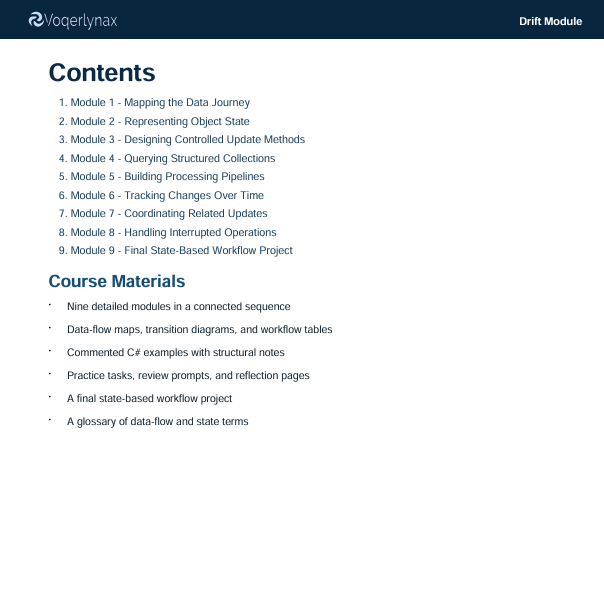
Module 1: Mapping the Data Journey
The opening module explains how to describe the complete route of a value. Learners create flow maps that show input, validation, processing, storage, retrieval, and output. Exercises focus on identifying where information may change and which class controls each stage.
Module 2: Working With Object State
Learners examine how objects represent changing conditions over time. Lessons cover status properties, controlled updates, valid transitions, and records of previous values. Examples include task stages, order states, lesson progress, and review conditions.
Module 3: Controlled Update Methods
This module explains why object data should change through focused methods rather than scattered assignments. Learners create methods that check conditions before applying an update. Practice tasks include changing statuses, updating grouped records, and rejecting invalid transitions.
Module 4: Querying Structured Collections
Learners work with collections containing related objects and practise selecting, filtering, sorting, and grouping records. The module explains how query operations can be separated from modification logic. Exercises use readable conditions and clearly named result groups.
Module 5: Processing Pipelines
This section introduces multi-stage processing through small connected components. Learners divide a broad operation into preparation, validation, calculation, and output stages. Diagrams illustrate how each stage receives information and passes a revised value forward.
Module 6: Tracking Changes
Learners create simple history records that describe what changed, when it changed, and which operation caused the update. The module explores change descriptions, previous and current values, and grouped activity records.
Module 7: Coordinating Related Updates
This module examines situations where one change affects several connected objects. Learners practise coordinating updates through one responsible component instead of modifying each object separately. Examples include moving records between groups and updating summary values.
Module 8: Handling Interrupted Operations
Learners study how to respond when one stage of a multi-step operation cannot continue. Exercises cover validation failures, missing records, incomplete updates, and clear error descriptions. The focus remains on preserving readable state and avoiding partial changes.
Module 9: Data-Flow Review Task
The concluding task asks learners to build a structured workflow for managing records through several states. They map the data journey, define update rules, create query methods, track changes, and review the final communication paths.
Included Materials
Drift Module contains written modules, code samples, flow diagrams, state-planning worksheets, guided exercises, review questions, refactoring activities, and a concluding workflow task.
4. Who Is This For?
Drift Module is intended for learners who already understand classes, interfaces, collections, validation, and layered code organisation. It suits students continuing from Quantum Archive and those who want focused practice with information movement, state control, and coordinated updates.
5. What You’ll Learn
- Map information through several components
- Define clear object states
- Create controlled update methods
- Describe valid and invalid state transitions
- Filter and group structured collections
- Separate queries from modification logic
- Build multi-stage processing pipelines
- Record changes in a readable format
- Coordinate updates across related objects
- Respond to interrupted operations
- Avoid partial or inconsistent state changes
- Trace values through a full workflow
- Review responsibility boundaries
- Refactor unclear data movement
- Build a state-based course exercise
6. 30-Day Refund Policy
A refund request may be submitted within 30 calendar days of the purchase date. Each request is reviewed according to the store terms displayed during checkout. Order details may be requested to identify the transaction and review the request. Approved refunds are returned through the original payment method under the processing conditions of the payment provider.
Self-paced learning overview
- 📦 Digital file available after purchase
- 🔄 Long-term availability
- 🛡️ Secure checkout
- 🔄 Content updated in 2026
How are the Voqerlynax courses structured?
How are the Voqerlynax courses structured?
Each course is divided into focused modules that introduce concepts in a logical order. Lessons combine explanations, code examples, review notes, and practical exercises. The structure allows learners to study one topic at a time while seeing how separate C# concepts connect.
Do I need previous C# knowledge?
Do I need previous C# knowledge?
Previous knowledge is not required for the introductory course. Later course tiers gradually introduce broader topics, larger exercises, and more detailed coding structures. Learners can select a course that matches their current knowledge and study goals.
What materials are included?
What materials are included?
Course contents may include written lessons, code examples, guided exercises, reference notes, practice tasks, module summaries, and review questions. The exact selection depends on the course tier and its subject focus. Each description explains the included materials in detail.
Share