Voqerlynax
Echo Framework
Echo Framework
Couldn't load pickup availability
1. Problem Statement
As C# exercises grow, repeated logic can appear across several classes and methods. Learners may copy similar code into different sections because they are unsure how to create a shared structure. This repetition makes code harder to review, adjust, and explain. Class responsibilities may also overlap, causing data handling, calculations, and validation to become mixed together. A more organized approach is needed to create reusable components while keeping each part understandable.
2. Solution
Echo Framework introduces methods for identifying repeated patterns and placing shared logic into suitable structures. Learners examine how interfaces, inheritance, composition, and reusable methods can support organized code. Each topic is introduced through small examples before being used in broader exercises. Planning tasks help learners decide which responsibilities belong together and which should remain separate. Code review activities encourage careful naming, focused classes, and readable relationships.
3. What’s Inside
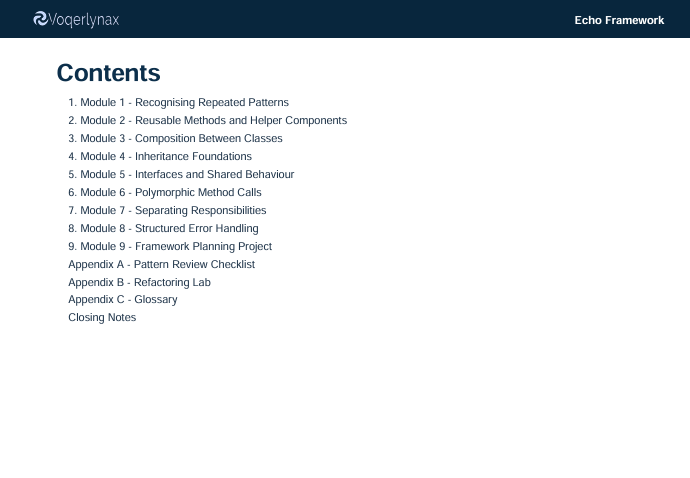
Module 1: Recognizing Repeated Patterns
The opening module explains how to identify code that performs similar work in several places. Learners compare repeated methods, duplicated conditions, and related data structures. Exercises focus on describing the shared purpose before changing the code.
Module 2: Reusable Methods and Helper Classes
This module examines how shared calculations, formatting rules, and validation checks can be placed into focused methods or helper classes. Learners review method signatures, returned values, parameter choices, and naming. Practice tasks involve reorganizing repeated instructions into reusable sections.
Module 3: Composition Between Classes
Learners study how one class can contain or coordinate other objects. Examples include records with contact details, catalogs with entries, and schedules with grouped items. The module explains how composition can represent clear relationships without placing every responsibility inside one class.
Module 4: Introductory Inheritance
This section introduces parent and child class relationships. Learners examine shared properties, inherited methods, and specialized behavior. Exercises compare situations where inheritance is suitable with cases where composition creates a clearer structure.
Module 5: Interfaces and Shared Behaviour
Learners explore interfaces as descriptions of common actions. Guided examples show how different classes can follow the same method structure while providing their own implementation. Activities include creating simple reporting, formatting, and calculation behaviours.
Module 6: Polymorphic Method Calls
This module explains how objects with a shared interface or parent type can be handled through one coordinated process. Learners work with grouped objects and observe how each object responds according to its own implementation.
Module 7: Separating Responsibilities
Learners examine classes that contain too many unrelated tasks. They practise dividing storage, validation, calculation, and presentation logic into focused components. Review questions help identify unclear boundaries and unnecessary dependencies.
Module 8: Error Handling Foundations
This section introduces structured handling of unexpected values and interrupted operations. Learners examine guarded code blocks, informative messages, and sensible recovery paths. Exercises focus on keeping error handling separate from the central task.
Module 9: Framework Planning Exercise
The concluding exercise asks learners to design a small class system from a written scenario. They define responsibilities, relationships, shared behaviours, and reusable components before writing the code. The task concludes with a structured review of naming, repetition, and class boundaries.
Included Learning Materials
Echo Framework includes written modules, code examples, planning worksheets, guided refactoring tasks, terminology notes, review questions, and a concluding design exercise.
4. Who Is This For?
Echo Framework is intended for learners who understand classes, objects, methods, and collections and want to study broader code relationships. It is suitable for learners continuing from Lattice Guide or those with comparable knowledge. The course is also useful for students who want more practice with reusable logic and coordinated class structures.
5. What You’ll Learn
- Identify repeated code patterns
- Create reusable methods
- Organize shared logic in helper classes
- Build relationships through composition
- Describe parent and child class structures
- Create and implement interfaces
- Work with shared object types
- Compare inheritance and composition
- Separate validation from calculations
- Divide broad classes into focused components
- Add structured error handling
- Plan relationships before writing code
- Review class responsibilities
- Refactor repeated instructions
- Build a coordinated multi-class exercise
6. 30-Day Refund Policy
A refund request may be submitted within 30 calendar days of the purchase date. Requests are reviewed according to the store terms shown during checkout. Transaction details may be requested to identify the order and review the request. Approved refunds are returned through the original payment method under the processing conditions of the payment provider.
Self-paced learning overview
- 📦 Digital file available after purchase
- 🔄 Long-term availability
- 🛡️ Secure checkout
- 🔄 Content updated in 2026
How are the Voqerlynax courses structured?
How are the Voqerlynax courses structured?
Each course is divided into focused modules that introduce concepts in a logical order. Lessons combine explanations, code examples, review notes, and practical exercises. The structure allows learners to study one topic at a time while seeing how separate C# concepts connect.
Do I need previous C# knowledge?
Do I need previous C# knowledge?
Previous knowledge is not required for the introductory course. Later course tiers gradually introduce broader topics, larger exercises, and more detailed coding structures. Learners can select a course that matches their current knowledge and study goals.
What materials are included?
What materials are included?
Course contents may include written lessons, code examples, guided exercises, reference notes, practice tasks, module summaries, and review questions. The exact selection depends on the course tier and its subject focus. Each description explains the included materials in detail.
Share