Voqerlynax
Lattice Guide
Lattice Guide
Couldn't load pickup availability
1. Problem Statement
Learners often understand individual C# statements but find it difficult to combine them into a complete coding structure. Variables, methods, conditions, loops, and classes may work separately while becoming confusing when placed together. Larger exercises can also become difficult to read when responsibilities are mixed inside the same code block. Without a clear approach to organization, small changes may affect several unrelated parts of the code. Learners therefore need a structured way to connect foundational concepts while maintaining readability.
2. Solution
Lattice Guide presents C# as a network of related elements rather than a collection of isolated syntax rules. Each module explains how one concept communicates with the surrounding code structure. Learners work through gradually expanded examples that begin with simple instructions and develop into organized class-based exercises. Practical tasks encourage the separation of data, decisions, calculations, and reusable actions. Review materials help learners examine their code and identify areas that can be arranged more clearly.
3. What’s Inside
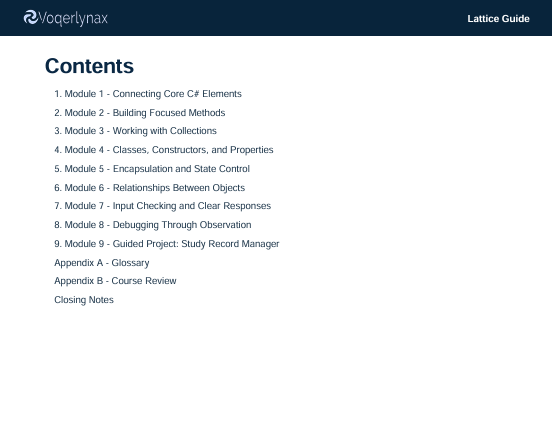
Module 1: Connecting Core C# Elements
The course begins with a review of variables, conditions, loops, and methods. Instead of studying them separately, learners examine how these elements work together inside one coding task. Examples demonstrate how data moves from an initial value through decisions, calculations, and final output.
Module 2: Building Structured Methods
This module explores how methods can divide a larger task into smaller responsibilities. Learners work with parameters, return values, method names, and calling sequences. Exercises focus on avoiding repeated instructions and keeping each method connected to one clear purpose.
Module 3: Organizing Data With Collections
Learners are introduced to structures used for storing groups of related values. Lessons explain how to create, read, update, filter, and review collections. Practice tasks include lists of names, numeric records, categories, and grouped information.
Module 4: Working With Classes and Objects
This section expands the introductory class concepts covered in Free Capsule. Learners create classes with properties, constructors, and methods. Guided examples show how objects can represent people, books, orders, schedules, and other structured records.
Module 5: Encapsulation and Clear Responsibilities
Learners examine how data and related actions can remain grouped inside a class. The module discusses public and private members, validation logic, controlled updates, and separation of responsibilities. Examples demonstrate why certain information should be changed through methods rather than directly.
Module 6: Relationships Between Objects
This module introduces connections between multiple objects. Learners explore how one object can contain, reference, or work with another object. Exercises include categories containing items, schedules containing entries, and groups containing individual records.
Module 7: Handling Input and Validation
Learners study how values can be checked before they are used. Lessons cover empty values, number ranges, text conditions, and repeated requests for corrected information. The emphasis remains on readable decision structures and clear feedback.
Module 8: Debugging Through Observation
This section presents a calm method for examining unexpected code behavior. Learners trace values, review conditions, check method calls, and divide a problem into smaller parts. Practice activities include locating logic mistakes and rewriting unclear code sections.
Module 9: Guided Course Exercise
The final exercise combines classes, collections, methods, conditions, and validation. Learners build a small record-management structure from a written specification. Each stage includes planning notes, coding tasks, review questions, and suggestions for further experimentation.
Included Learning Materials
Lattice Guide contains written modules, code samples, guided exercises, terminology notes, review questions, planning worksheets, debugging checklists, and a concluding course exercise. Each section is arranged to support gradual study and practical repetition.
4. Who Is This For?
Lattice Guide is intended for learners who already recognize basic C# syntax and want to connect individual concepts into larger exercises. It is suitable for students who have completed Free Capsule or have comparable introductory knowledge. The course may also help returning learners review classes, methods, collections, and code organization through a structured sequence.
5. What You’ll Learn
- Connect variables, conditions, loops, and methods
- Divide larger tasks into focused methods
- Work with collections of related values
- Create classes with properties and constructors
- Build and update objects
- Group data and related actions
- Apply public and private members
- Validate text and numeric values
- Create relationships between several objects
- Trace values through a coding sequence
- Identify repeated or unclear instructions
- Separate data handling from decision logic
- Plan a class-based exercise before writing code
- Review code structure and naming
- Combine several modules in one concluding task
6. 30-Day Refund Policy
A refund request may be submitted within 30 calendar days of the purchase date. Each request is reviewed according to the store terms presented at checkout. Order information may be requested to confirm the transaction and evaluate the request. Approved refunds are returned through the original payment method according to the processing conditions of the payment provider.
Self-paced learning overview
- 📦 Digital file available after purchase
- 🔄 Long-term availability
- 🛡️ Secure checkout
- 🔄 Content updated in 2026
How are the Voqerlynax courses structured?
How are the Voqerlynax courses structured?
Each course is divided into focused modules that introduce concepts in a logical order. Lessons combine explanations, code examples, review notes, and practical exercises. The structure allows learners to study one topic at a time while seeing how separate C# concepts connect.
Do I need previous C# knowledge?
Do I need previous C# knowledge?
Previous knowledge is not required for the introductory course. Later course tiers gradually introduce broader topics, larger exercises, and more detailed coding structures. Learners can select a course that matches their current knowledge and study goals.
What materials are included?
What materials are included?
Course contents may include written lessons, code examples, guided exercises, reference notes, practice tasks, module summaries, and review questions. The exact selection depends on the course tier and its subject focus. Each description explains the included materials in detail.
Share