Voqerlynax
Nexus Series
Nexus Series
Couldn't load pickup availability
1. Problem Statement
Larger C# projects often contain many components that need to exchange information without becoming tightly connected. Learners may place coordination logic across several classes, making it difficult to trace where an operation begins and ends. Changes to one component can then require adjustments in unrelated sections. Communication rules may also become inconsistent when each class passes information in a different format. A clear connection model is needed to keep broad code structures readable and manageable.
2. Solution
Nexus Series presents a structured approach to communication between C# components. Learners define clear contracts, request models, response models, and coordination points before implementing broader workflows. Each module examines how information moves between separate areas while preserving focused responsibilities. Guided exercises demonstrate how events, interfaces, and mediator-style components can reduce unnecessary direct relationships. Review activities help learners evaluate communication paths, dependency direction, and the placement of shared rules.
3. What’s Inside
Module 1: Mapping Communication Paths
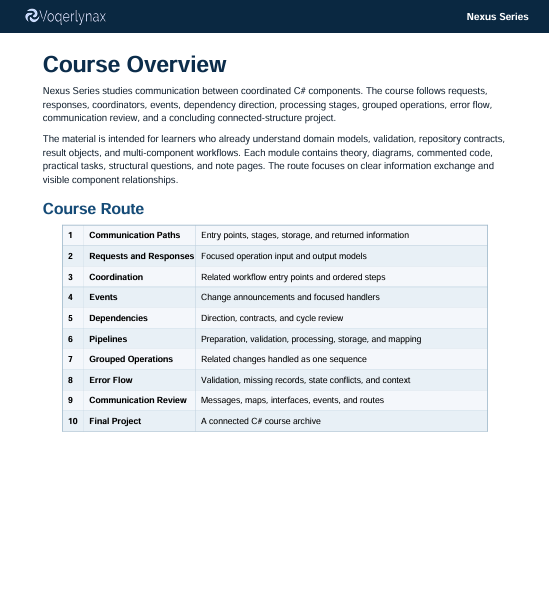
The opening module introduces diagrams that show how requests move through a code structure. Learners identify entry points, processing stages, storage operations, and returned information. Exercises focus on removing unclear or repeated communication routes.
Module 2: Request and Response Models
Learners create focused models that describe incoming information and returned details. Lessons cover property selection, validation notes, status descriptions, and error information. Practice tasks show how separate models can reduce direct exposure of internal class structures.
Module 3: Coordination Services
This module examines classes that guide an operation through several components. Learners connect validation, processing, and storage behaviour through one clear coordination route. Examples include creating records, editing grouped information, and retrieving filtered data.
Module 4: Event-Based Communication
Learners explore how one component can announce that something has changed without directly controlling every related action. The module introduces events, event arguments, subscriptions, and focused handlers. Exercises include status changes, record updates, and activity notifications.
Module 5: Dependency Direction
This section explains how dependency direction affects code readability. Learners examine inward and outward dependencies, shared contracts, and replaceable implementations. Review tasks involve simplifying structures where high-level logic depends too directly on detailed components.
Module 6: Shared Processing Pipelines
Learners build reusable pipelines for validation, preparation, processing, and response creation. Each stage has a defined responsibility and communicates through structured values. Activities include rearranging broad methods into smaller connected stages.
Module 7: Transactional Thinking
This module studies operations containing several related changes. Learners plan how updates should be grouped, reviewed, and rejected when one stage cannot continue. The emphasis is on preventing partially updated records and preserving clear state.
Module 8: Cross-Component Error Flow
Learners examine how error details can travel through several areas without being duplicated or hidden. Examples include invalid requests, missing records, conflicting updates, and interrupted processing.
Module 9: Communication Review
This section introduces checklists for reviewing message formats, dependency paths, event handlers, and coordination logic. Learners identify unclear boundaries and revise overly connected code.
Module 10: Connected Structure Exercise
The concluding task asks learners to build a multi-area record system. They define communication models, create coordination services, add events, organise processing stages, and review the final dependency map.
Included Materials
Nexus Series contains written modules, code examples, communication diagrams, planning worksheets, event exercises, review checklists, refactoring activities, and a concluding connected-structure task.
4. Who Is This For?
Nexus Series is intended for learners who already understand interfaces, layered code organisation, repositories, validation components, and coordinated workflows. It suits students continuing from Vertex Collection and learners who want deeper practice with communication between multiple C# areas.
5. What You’ll Learn
- Map communication between components
- Create focused request and response models
- Build coordination services
- Work with events and event handlers
- Reduce direct component relationships
- Review dependency direction
- Build reusable processing pipelines
- Group related updates
- Handle interrupted multi-stage operations
- Organise error information
- Trace requests through several areas
- Review communication contracts
- Refactor overly connected structures
- Document event and dependency paths
- Build a connected multi-component exercise
6. 30-Day Refund Policy
A refund request may be submitted within 30 calendar days of the purchase date. Requests are reviewed according to the store terms displayed during checkout. Order details may be requested to identify the transaction and examine the request. Approved refunds are returned through the original payment method according to the processing conditions of the payment provider.
Self-paced learning overview
- 📦 Digital file available after purchase
- 🔄 Long-term availability
- 🛡️ Secure checkout
- 🔄 Content updated in 2026
How are the Voqerlynax courses structured?
How are the Voqerlynax courses structured?
Each course is divided into focused modules that introduce concepts in a logical order. Lessons combine explanations, code examples, review notes, and practical exercises. The structure allows learners to study one topic at a time while seeing how separate C# concepts connect.
Do I need previous C# knowledge?
Do I need previous C# knowledge?
Previous knowledge is not required for the introductory course. Later course tiers gradually introduce broader topics, larger exercises, and more detailed coding structures. Learners can select a course that matches their current knowledge and study goals.
What materials are included?
What materials are included?
Course contents may include written lessons, code examples, guided exercises, reference notes, practice tasks, module summaries, and review questions. The exact selection depends on the course tier and its subject focus. Each description explains the included materials in detail.
Share