Voqerlynax
Peak Series
Peak Series
Couldn't load pickup availability
1. Problem Statement
A broad C# codebase can become difficult to maintain when new features are added without reviewing the existing structure. Classes may collect unrelated responsibilities, while methods grow beyond their original purpose. Dependencies can spread across several areas and make small adjustments harder to plan. Repeated processing rules may also appear under different names, creating inconsistent behaviour. Learners need a structured way to examine an existing codebase and improve its organisation without rebuilding every component.
2. Solution
Peak Series introduces a review-led approach to refining larger C# structures. Learners examine responsibilities, dependencies, workflows, naming, and data movement before changing implementation details. Each module presents practical techniques for dividing broad components and reducing repeated instructions. Guided exercises show how to preserve existing behaviour while adjusting internal organisation. The concluding task brings these methods together through a detailed codebase review and revision plan.
3. What’s Inside
Module 1: Codebase Mapping
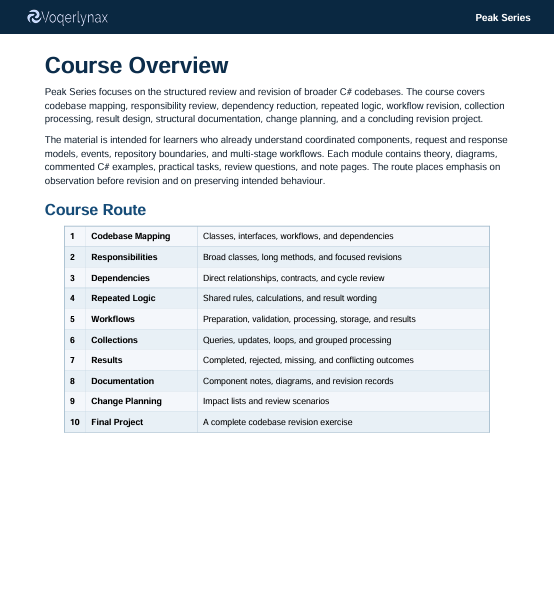
Learners begin by creating a visual map of classes, interfaces, workflows, and dependencies. The module explains how to identify central components, supporting areas, and communication routes. Activities focus on describing the current structure before proposing changes.
Module 2: Responsibility Review
This section examines classes and methods that perform several unrelated tasks. Learners divide broad responsibilities into focused areas and document the reason behind each adjustment. Comparison exercises show how smaller components can clarify code behaviour.
Module 3: Dependency Reduction
Learners identify direct connections that make components difficult to change separately. Lessons explore shared contracts, constructor-based dependencies, coordination classes, and replaceable implementations. Practice tasks focus on simplifying communication paths.
Module 4: Refactoring Repeated Logic
This module studies repeated calculations, validation rules, formatting instructions, and status checks. Learners compare duplicated sections and move shared behaviour into suitable methods or components while preserving readable names.
Module 5: Workflow Revision
Learners trace multi-stage operations from input to final response. They examine where validation, processing, storage, and error handling occur. Exercises involve rearranging unclear workflows into focused stages with documented responsibilities.
Module 6: Performance Awareness
This section introduces practical observation of repeated collection searches, unnecessary object creation, and broad processing loops. Learners compare alternative structures and document why one approach may require fewer operations. The focus remains on readable decisions rather than technical claims.
Module 7: Error and Result Design
Learners review how invalid values, missing records, and interrupted operations are represented. They create consistent result structures and keep error descriptions connected to the relevant responsibility.
Module 8: Documentation Practices
This module covers class summaries, method notes, architecture diagrams, naming records, and decision logs. Learners practise writing documentation that explains purpose and relationships without repeating visible code.
Module 9: Change Planning
Learners prepare structured plans for adding or revising a feature. Activities include identifying affected components, documenting dependency changes, listing validation updates, and preparing review steps.
Module 10: Codebase Revision Exercise
The concluding task presents a multi-component C# structure containing repeated logic, broad classes, and unclear dependencies. Learners map the structure, identify revision areas, refactor selected sections, and prepare a written review of their decisions.
Included Materials
Peak Series includes written modules, code examples, architecture maps, revision worksheets, dependency diagrams, refactoring tasks, review checklists, documentation templates, and a concluding codebase exercise.
4. Who Is This For?
Peak Series is intended for learners who already understand layered structures, interfaces, repositories, events, processing pipelines, and coordinated workflows. It suits students continuing from Nexus Series and learners who want to study code review, structural revision, and long-term organisation.
5. What You’ll Learn
- Map a broad C# codebase
- Review class and method responsibilities
- Identify unnecessary dependencies
- Refactor repeated processing rules
- Divide broad workflows into focused stages
- Review collection-processing patterns
- Create consistent result structures
- Organise error information
- Document architecture decisions
- Prepare change-impact notes
- Preserve behaviour during structural revisions
- Review naming across connected components
- Create dependency and workflow diagrams
- Build a revision checklist
- Complete a guided codebase review
6. 30-Day Refund Policy
A refund request may be submitted within 30 calendar days of the purchase date. Requests are reviewed according to the store terms displayed during checkout. Order details may be requested to identify the transaction and examine the request. Approved refunds are returned through the original payment method according to the processing conditions of the payment provider.
Self-paced learning overview
- 📦 Digital file available after purchase
- 🔄 Long-term availability
- 🛡️ Secure checkout
- 🔄 Content updated in 2026
How are the Voqerlynax courses structured?
How are the Voqerlynax courses structured?
Each course is divided into focused modules that introduce concepts in a logical order. Lessons combine explanations, code examples, review notes, and practical exercises. The structure allows learners to study one topic at a time while seeing how separate C# concepts connect.
Do I need previous C# knowledge?
Do I need previous C# knowledge?
Previous knowledge is not required for the introductory course. Later course tiers gradually introduce broader topics, larger exercises, and more detailed coding structures. Learners can select a course that matches their current knowledge and study goals.
What materials are included?
What materials are included?
Course contents may include written lessons, code examples, guided exercises, reference notes, practice tasks, module summaries, and review questions. The exact selection depends on the course tier and its subject focus. Each description explains the included materials in detail.
Share