Voqerlynax
Slate Blueprint
Slate Blueprint
Couldn't load pickup availability
1. Problem Statement
Learners often begin writing code before deciding how the complete structure should work. This can lead to classes with unclear responsibilities, repeated logic, and relationships that become difficult to follow. Requirements may also change during development, revealing that the original structure cannot be adjusted without rewriting several sections. When planning is skipped, naming decisions and data flow may become inconsistent across the project. Learners therefore need a practical method for translating an idea into a clear C# blueprint.
2. Solution
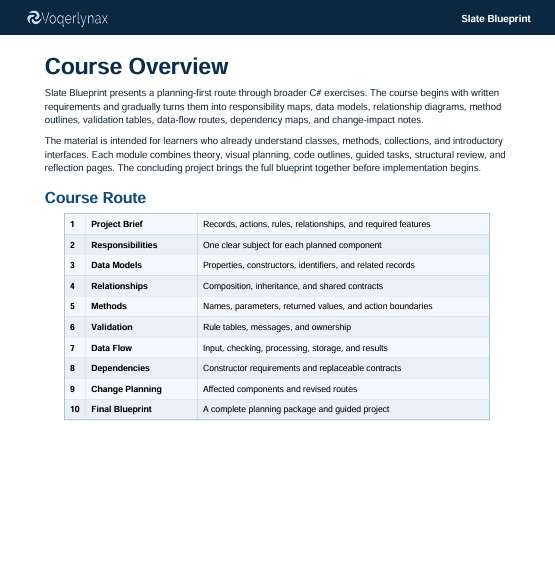
Slate Blueprint introduces a planning-first approach to C# development. Learners begin with written requirements and gradually convert them into models, responsibilities, relationships, and processing steps. Each module includes diagrams and worksheets that help organize ideas before implementation. Guided tasks show how planning choices affect readability, flexibility, and future adjustments. The final exercise brings these methods together in a complete structure created from an initial project brief.
3. What’s Inside
Module 1: Reading a Project Brief
The course begins with methods for reviewing a written scenario. Learners identify key nouns, actions, rules, and relationships that may become classes, properties, methods, or validation conditions. Exercises focus on separating required features from optional ideas.
Module 2: Defining Responsibilities
Learners create responsibility lists for each proposed component. The module explains how to avoid placing unrelated tasks inside one class. Guided examples compare broad classes with smaller, focused alternatives.
Module 3: Planning Data Models
This section covers model design, property selection, constructors, identifiers, and relationships between records. Learners examine which values belong together and which should be represented by separate objects.
Module 4: Mapping Class Relationships
Learners work with diagrams showing composition, inheritance, shared interfaces, and coordinated services. Activities encourage learners to select relationships based on the purpose of each component rather than visual similarity alone.
Module 5: Designing Method Signatures
This module examines method names, parameters, returned values, and expected responsibilities. Learners create method outlines before writing implementation details. Practice tasks focus on keeping each method connected to one clear action.
Module 6: Planning Validation Rules
Learners document rules for text, numeric values, dates, status changes, and related records. The module demonstrates how validation requirements can be grouped and reused across several components.
Module 7: Mapping Data Flow
This section shows how information travels through input, validation, processing, storage, and output. Learners build flow diagrams and identify where data may change during each stage.
Module 8: Reviewing Dependencies
Learners examine how components rely on one another. Exercises involve removing unnecessary connections, introducing shared contracts, and keeping communication paths visible.
Module 9: Preparing for Change
This module explores how a structure can accommodate revised rules or additional features. Learners review examples where small planning decisions affect later adjustments.
Module 10: Blueprint Exercise
The concluding task begins with a written scenario. Learners create a responsibility map, model outline, relationship diagram, method plan, validation table, and data-flow sequence before writing the core C# structure.
Included Materials
Slate Blueprint contains written modules, planning worksheets, structural diagrams, code outlines, guided exercises, review questions, comparison examples, and a concluding blueprint task.
4. Who Is This For?
Slate Blueprint is intended for learners who understand classes, methods, collections, interfaces, and layered structures. It suits students continuing from Drift Module and learners who want to strengthen their approach to planning before implementation. The course is also suitable for people who can write working code but want to arrange ideas more clearly before beginning a larger exercise.
5. What You’ll Learn
- Interpret written coding requirements
- Identify possible classes and responsibilities
- Plan properties, constructors, and identifiers
- Create class relationship diagrams
- Compare composition and inheritance
- Outline method signatures
- Document validation rules
- Map information movement
- Review component dependencies
- Separate required features from optional ideas
- Prepare structures for revised requirements
- Evaluate naming and responsibility choices
- Create planning worksheets
- Convert a project brief into a C# structure
- Review a blueprint before implementation
6. 30-Day Refund Policy
A refund request may be submitted within 30 calendar days of the purchase date. Requests are reviewed according to the store terms presented during checkout. Order information may be required to locate the transaction and assess the request. Approved refunds are returned through the original payment method according to the processing conditions of the payment provider.
Self-paced learning overview
- 📦 Digital file available after purchase
- 🔄 Long-term availability
- 🛡️ Secure checkout
- 🔄 Content updated in 2026
How are the Voqerlynax courses structured?
How are the Voqerlynax courses structured?
Each course is divided into focused modules that introduce concepts in a logical order. Lessons combine explanations, code examples, review notes, and practical exercises. The structure allows learners to study one topic at a time while seeing how separate C# concepts connect.
Do I need previous C# knowledge?
Do I need previous C# knowledge?
Previous knowledge is not required for the introductory course. Later course tiers gradually introduce broader topics, larger exercises, and more detailed coding structures. Learners can select a course that matches their current knowledge and study goals.
What materials are included?
What materials are included?
Course contents may include written lessons, code examples, guided exercises, reference notes, practice tasks, module summaries, and review questions. The exact selection depends on the course tier and its subject focus. Each description explains the included materials in detail.
Share